
炒股就看金麒麟分析师研报,泰斗,专科,实时开云(中国)Kaiyun·体育官方网站-登录入口,全面,助您挖掘后劲主题契机!
花旗万字神文精译:若何赢得买卖与通胀之战?买卖战的最终战场在外汇商场,中国的有盘算推算将决定好意思国经济走向
来源:地平线全球策略
花旗总管Mohammed Apabhai的一篇神文,他在上周四名胜般地押中了特朗普的关税税率安排,华尔街以至有东说念主合计Mohammed是不是拿到了什么内幕音讯..
全文共三部分,精校会在这几天不竭发出,
本文是第一部分,全球拨冗阅读。
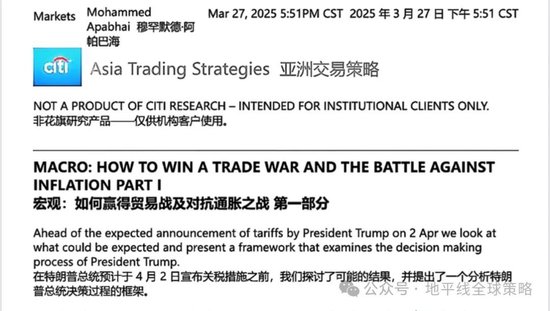
Ahead of the expected announcement of tariffs by President Trump on 2 Apr we look at what could be expected and present a framework that examines the decision making process of President Trump.
在特朗普总统瞻望于4月2日晓谕关税步调之前,本文探讨了可能的圮绝,并建议了一个分析特朗普有盘算推算进程的框架。
Imagine that two people are playing a game - person A has been given $100 but has to share that with person B. Person A makes the offer of how much to share with person B which can either be taken or rejected - if person B takes the offer both people get the amount of money they have agreed to. If person B rejects the offer then neither party gets anything. How much should person A offer?
假定两个东说念主在玩一个游戏——A得到了一百好意思元,但必须与B共享。A建议给B些许钱的建议,B不错遴荐经受或拒却。
要是B经受,两边将按商定金额赢得各自的钱;要是B拒却,则两边都得不到任何钱。那A应该建议些许金额的分拨才合理?
The answer to this problem is an interesting problem in mathematics - the best part of economics is always mathematics. At first glance, it appears that the “fair” offer that should be made should be to split the money 50:50. Until it is realized that person B has got no money so even the offer of $1 leaves him better than where he starts off. The optimal Nash equilibrium is for person A to offer the smallest amount of money possible. However, if person B knows that person A is going to walk away with the bulk of the money, the sense of injustice may trigger person B to reject the offer because he knows he is causing more damage to person A.
这个问题在数学上是个很真义的案例——经济学中最精彩的部分遥远是数学。乍一看,似乎“平正”的提议应该是五五分红。但一朝意志到B手头一无扫数,那么即使只得到1好意思元,他的处境也比领先更好。
按照纳什平衡的表面,A最优的遴荐是建议一个尽可能低的金额。
然则,要是B意志到A将带走绝大部分的钱,这种不公感可能会促使他拒却提议,因为他知说念这么会对A形成更大的亏蚀。
This “ultimatum problem” is a fascinating area of study and has applications in many areas including insurance claims, wage negotiations and most importantly for us, trade wars. Insurance companies generally offer around 11% of the amount claimed relying on the claimant’s desperation for financial relief and for the problem to go away as well as their financial strength to low ball offers. Under certain utility conditions it can be shown that the optimal level for person A to offer and which person B will consider acceptable is $30. Anything below $30 tends to get rejected as it causes a sense of grievance.
这一“终末通牒问题”是一个眷顾不舍的计划领域,平庸应用于保障理赔、工资谈判,尤其是与咱们关连最密切的买卖战。
保障公司经常只提供约11%的理赔金额,这种策略依赖于索赔东说念主急需财务挽救、但愿尽快了结问题的姿色,以及保障公司自身广博的财务才略,从而压低报价。在某些效力函数条款下不错解说,A建议并被B经受的最优金额是30好意思元。任何低于30好意思元的报价时常会被拒却,因为它会引发强烈的活气厚谊。
We have repeated this experiment with audiences of hundreds if not thousands of people around the world (having to give away a lot of money in the process when a deal is reached) and the differences in countries and professions is stark. Audiences in Malaysia in particular are willing to strike a fair bargain while healthcare workers also offer 50%. Lawyers generally tend to offer around 30% while those in finance tend to offer less than 30% (often less than 10%) and subsequently seem to have the highest proportion of deal rejections.
咱们在全球范围内对上百以至上千名不雅众重叠了这个实验(在达成交游时必须确实送出不少钱),圮绝袒露列国和各行业之间的各异相等彰着。
马来西亚的参与者尤其忻悦达成平正交游,医疗行业的从业者也倾向于建议50%的对半分红。讼师经常建议大致30%的分拨,而金融从业者则倾向于低于30%(好多时代以至不到10%),何况他们碰到交游被拒却的比例最高。
It is interesting to see this within the context of the Sino-US trade dispute. When we look at the share of bilateral trade, we find that the US share has been averaging just 21.1% since the GFC triggering the sense of unfairness.
在中好意思买卖争端的布景下来看这一问题尤其真义。
当咱们不雅察双边买卖份额时会发现,自2008年全球金融危急以来,好意思国的平均份额仅为21.1%,这在一定进程上引发了“抵拒正”的厚谊。
The trade agreement that was reached between the US and China in 2019 was aimed at redressing that imbalance. That agreement has clearly failed as the US share of bilateral trade has increased only from 18.2% in 2018 to 22.4% in 2020 when President Trump left office and had risen to only 24.5% when President Biden left office. The low share of bilateral trade has left the US with a sense of grievance.
2019年好意思中达成的买卖合同欢喜在于检阅这一失衡阵势。但该合同显着未能奏效——特朗普总统离任时,好意思国在双边买卖中的份额仅从2018年的18.2%升至2020年的22.4%;而到拜登总统任期末端时,这一比例也仅升至24.5%。耐久的低占比令好意思国产生了抓续的活气厚谊。
The track record of the Obama, Trump and Biden administrations, in terms of curbing the trade deficit and increasing the US share of bilateral trade is mixed. Statistically there appears to be little difference between any of the administrations.
奥巴马、特朗普与拜登政府在摧折买卖逆差和晋升好意思方买卖份额方面的进展可谓好坏各半。从统计数据来看,这几届政府的策略恶果各异甚微。
President Trump’s answer to the problem is the introduction of tariffs. It is often thought that the numbers that President Trump talks about are random - that he just pulls out some fairly random numbers for the tariff rates that he is setting. The evidence suggests that this may not be the case, that there may be a plan behind the action.
特朗普总统对这一问题的汇报是加征关税。外界普遍认为他设定的关税税率熟谙交接——似乎仅仅随口报出一串数字。然则,有迹象标明,情况可能并非如斯,这些举措背后好像存在一套系统性的考量。
Last year the US imported $429.6bn of goods from China and exported only $139.7bn resulting in total bilateral trade of $569.3bn and a trade deficit of $289.9bn. It is instructive to look not only at how much the application of tariffs would raise - in this context tariffs are seen as a US tax which would fall partly on the Chinese exporter who in 2019 was forced to absorb them by cutting their margins and partly by the consumer. It is unclear at this moment where the burden of the new round of tariffs will fall.
客岁,好意思国自中国入口商品总和达4296亿好意思元,而出口仅1397亿好意思元,双边买卖总和为5693亿好意思元,买卖逆差高达2899亿好意思元。
此时关税的真义不仅在于“征收了些许钱”,更值得眷注的是它在谁身上顺利。在这种布景下,关税践诺上被视为一种“好意思国税”,2019年中国出口商被动通过压缩利润来消化其中一部分,另一部分则由糟践者承担。至于新一轮关税的最终背负将由谁承担,现时仍不汜博。
Now if we look at the “whole” trade balance including the tariffs we start to see what is happening. To completely eliminate the trade deficit with China, the US would need to impose a 67.5% tariff on all Chinese exports – with no retaliatory tariffs from China. President Trump has threatened to impose escalating tariffs of 10% per month up to a maximum of 70% (link), with the remainder likely to compensate for Chinese retaliation. This is the number needed to eliminate the US trade deficit with China.
要是将关税纳入“合座”买卖平衡的分析之中,就能看清实在的结构性问题。若要绝对排斥对华买卖逆差,好意思国需要对扫数中国出口商品征收67.5%的关税——且假定中国不膨胀任何报复性关税。
特朗普总统曾恫吓以每月10%的速率递加关税,最高可达70%,其中多出的部分可能用于对消中国的反制。
67.5%这个数字,即是表面上排斥逆差所需的关税水平。
The 10% tariff on all Chinese goods that President Trump announced on 1 Feb under Executive Order 14195 applies to all Chinese imports. The 10% tariff had the effect of rebalancing the US portion of bilateral share from 24.5% to 29.8%, just under the 30% minimum that the Nash equilibrium would have deemed as the “minimum acceptable”.
特朗普总统于2月1日依据第14195号行政大喊晓谕对扫数中国商品加征10%关税,该策略隐敝全部中国居品。
这次加征将好意思国在双边买卖中的占比从24.5%拉升至29.8%,略低于纳什平衡所界说的“最低可经受区间”30%。
Chinese retaliation so far has targeted an average of 12.5% tariffs on around $20bn of goods, taking the US share of bilateral trade to 29.7%. The small amount of tariff that it raised was hardly worth it, but falling below 30% meant that it invited US retaliation. The US share of bilateral trade is currently 29.7%, which is still not enough – the sense of grievance continues.
中国方面迄今的报复步调是对大致200亿好意思元商品加征平均12.5%的关税,使好意思国在双边买卖中的份额达到29.7%。天然加征的关税规摹本人并不权贵,但低于30%的占比意味着激励了好意思方的报复动机。
现时好意思国的份额仍处于29.7%,仍未达到舒畅水平,活气厚谊也曾存在。
It was for this reason that the next round of tariffs, which raised the levy to 20% on all Chinese imports, was not a surprise. The US now has 34.4% of bilateral trade which is in the minimum acceptable zone but given the past history and duration of the imbalance, as well as President Trump’s current expected utility function, this is unlikely to be satisfactory.
正因如斯,好意思国随后的加税升级——将扫数中国居品的关税提高至20%——并不令东说念主巧合。现时,好意思国在双边买卖中的占比升至34.4%,处于“最低可经受”区间。但探求到历史失衡的布景、抓续时辰,以及特朗普当下的预期效力函数,这一水平仍难被视为“舒畅”。
It is quite likely that the US will impose tariffs of close to 70% on Chinese goods to eliminate the trade deficit – that would then provide a good starting point to start trade negotiations. The actual point of agreement will depend on the individual utility functions of the respective leaderships in China and the USA.
好意思国很有可能对中国商品加征接近70%的关税,以绝对排斥买卖逆差——这将成为重新开动买卖谈判的一个“合理开头”。最终达成合同的位置,将取决于中好意思两国开荒东说念主各自的效力函数。
So far it would seem that the USA is keener to reach an agreement than China, even if it is a “bad” agreement. From that perspective the Biden approach to bilateral trade was, in some ways, more (although not quite) optimal.
放胆现时,好意思国似乎比中国更挫折地但愿达成合同,即条子件并不睬思。从这个角度来看,拜登在双边买卖中的作念法在某些方面反而更接近“次优解”,尽管并不王人备感性最优。
It is also instructive to look at the relationships with some of the other US trading partners with which it suffers large trade deficits.
不雅察好意思国与其他存在较大买卖逆差的国度的关连,相同具有启发真义。
Of the top ten deficit countries, trade with Mexico and Canada is more balanced than with the others.
在十大逆差国中,好意思国与墨西哥和加拿大之间的买卖相较其他国度愈加平衡。
What this suggests is that President Trump is using this as a “dry run” against relatively soft targets before moving onto the bigger targets like Vietnam, China. Most of the other countries are in the “acceptable but not fair” categorization.
这意味着特朗普践诺上正在将部分国度(如墨西哥、加拿大)动作“演练对象”,为将来对准越南、中国等更“大体量盘算推算”作念准备。在好意思方视角下,许多国度被划入“可经受但并抵拒正”的范围。
It is also instructive to look at the percentage tariffs needed on each country to rebalance the trade relationship. It can be shown that to rebalance trade requires a tariff percentage equal to the US trade deficit / imports.
值得进一步分析的是:要完了买卖关连再平衡,好意思国需要对列国商品加征的“表面关税比例”。不错解说,所需比例等于好意思国的买卖逆差除以该国对好意思出口。
To completely rebalance the relationship requires tariffs of 34% on Mexico with no retaliatory tariffs and 15.3% on Canada. The 25% tariff on Mexico gives the USA 47.6% of bilateral trade assuming no retaliation and with Canada gives 52.3% of bilateral trade – taken as a NAFTA block the 25% tariffs restores the US share of bilateral trade to 49.8%.
若要王人备重构好意思墨关连,则需对墨西哥征收34%的关税(前提是不遭报复);对加拿大则为15.3%。假定无报复举止,对墨征收25%关税会使好意思方在双边买卖中的份额升至47.6%;对加相同比例,则好意思方份额为52.3%。若以北好意思解脱买卖区(NAFTA)为合座,好意思国以25%关税可将其在区域双边买卖中的份额复原至49.8%。
Outside of China’s 67.5% tariffs, we expect tariffs of 63.6% on Taiwan, 52.2% on India, 50.2% on South Korea and 46.2% on Japan – retaliation will cause an increase in the US tariffs as it attempts to restore balance.
除中国67.5%的盘算推算关税外,模子预测好意思国可能对台湾加征63.6%、对印度52.2%、对韩国50.2%、对日本46.2%的关税——若遭报复,好意思国或进一步上调税率以复原买卖平衡。
Tariffs of this magnitude, if applied in full, would raise $1.3tn assuming no drop in international trade. This is to be compared to the projected US fiscal debt in 2025 of $2.5tn. Tariffs of this magnitude would fund over half the fiscal debt – if they could be successfully applied.
若按此关税幅度全面膨胀,且不探求海外买卖收缩影响,则表面上可带来约1.3万亿好意思元的税收。这一数字接近2025年好意思国瞻望财政赤字2.5万亿好意思元的一半——前提是这些关税能够实在告捷落地。
It is also instructive to see the level of tariffs needed to get to the minimum 30% acceptable region which could be the basis for trade negotiations…
计划达到“最低30%可经受区间”所需的关税水平也很有价值——这或可动作买卖谈判的开头……
…although we have to caution that at this stage it does not appear that the US is going for anything other than a complete elimination of the trade deficit.
……不外必须指出,现时好意思国的盘算推算似乎不是融合性谈判,而是绝对排斥买卖逆差。
It is possible that the Trump administration will do a deal on trade, especially given the seeming need for President Trump to achieve a deal, no matter how bad it is…
特朗普政府最终可能会达成某种买卖合同,尤其探求到特朗普个东说念主在政事周期中对“成交”有较强诉求,即使合同条款并不睬思……
…we are not there yet but especially if market movements impact his utility curve most countries may get away by negotiating away the tariffs. A deal is there to be done – not yet but under the right market conditions.
天然当下尚未走到这一步,但若商场变化权贵影响其“效力弧线”,多数国度可能有机通晓过谈判迟滞关税压力。交游朝夕会达成——天然还不是当今,但在得当的商场条款下,终将完了。
The impact of a trade war is to reduce bilateral trade. The trade war during President Trump’s first term reduced bilateral trade by 15.8%. We would expect this trade war to be more ferocious, reducing bilateral trade by 25%, with the brunt of the impact falling on China and other US trading partners. In the first term, the trade war resulted in a 16.8% drop in Chinese exports to the US but only an 11.4% drop in US exports to China.
买卖战的径直影响是减少双边买卖。特朗普总统第一任期内的买卖战导致双边买卖总量下跌15.8%。瞻望新一轮买卖战将更为厉害,可能使双边买卖减少25%,而中国过甚他好意思国主要买卖伙伴将首当其冲。在上一次买卖战中,中国对好意思出口下跌了16.8%,而好意思国对华出口仅下跌11.4%。
This can be analysed through the perspective of Rubinstein Bargaining, a simple game of alternating offers bargaining with a costly delay.
这一兴奋不错通过“鲁宾斯坦议价”(Rubinstein Bargaining)的视角来分析,它是一种带有蔓延资本的瓜代出价博弈模子。
The $100 is to be divided between the two players as in our Ultimatum Game, but if the offer is rejected then there is a financial penalty that is paid and the $100 reduces to some lower value until eventually it drops to zero.
与“终末通牒博弈”访佛,100好意思元将在两方之间分拨,但若提议被拒,则将产生一定的“刑事使命性资本”,即100好意思元的总价值会随时辰贬值,直到最终归零。
We will examine this in more detail as the trade war evolves. Suffice it to say that the 1982 paper by Rubinstein suggests that an optimal solution does exist.
跟着买卖战的演进,后续著述将深切分析这一模子。这里只需指出,鲁宾斯坦在1982年的论文中已解说,如实存在最优解。
So will tariffs work? To understand this we need to play another game. Would you prefer a $10 chocolate for $5 or a $3 chocolate for nothing?
那么关税究竟有用吗?为了蚁合这个问题,需要换个方法来看:你忻悦花5好意思元买一块价值10好意思元的巧克力,如故免费拿一块价值3好意思元的?
Clearly the $10 chocolate offers the higher economic value but theoretically as well as experimentally it can be shown that approximately 81.6% of people will take the $3 chocolate – it is to do with the “Theory of Free” which has implications for everything from healthcare services to advertising incentives.
显着,10好意思元的巧克力具有更高的经济价值,但从表面与实确认验都不错解说,约81.6%的东说念主会遴荐那块免费但价值较低的巧克力。这与“免费表面”(Theory of Free)密切关联,影响范围从医疗工作到告白激励,隐敝平庸。
Our utility function changes as soon as we need to pay for something – if something is free then we are invariant between having it or not having it and if it may potentially prove useful at some point in the future, we seem to prefer to have it.
一朝必须为某物付费,咱们的效力函数就会发生变化——若某物免费,东说念主们经常会对“领有与否”无感,但惟有它将来可能有用,大多数东说念主便会倾向于“先拿着再说”。
This probably explains why most households in the US and in the West more generally are full of cheap, fairly useless, Chinese products that may potentially be useful one day.
这也许能解释,为何好意思国乃至扫数这个词西方的许多家庭都堆满了低廉、并虚假用、但可能“某天会用得上”的中国居品。
China has priced these goods at a “zero marginal utility value” where consumers are invariant to owning or not – consumers are happy to pay a minimal amount for something just in case it comes in useful some day.
中国将这类商品订价在“零旯旮效力值”区间,即糟践者对是否领有无所回避——他们乐意花极廉价钱去买,只因“万一有用”。
To get them away from this and to stop them from purchasing these “useless” products, what needs to be done is to raise the cost that the consumer pays above the “zero marginal utility value”. This is potentially what tariffs might do.
若要令糟践者开脱这种“囤积式糟践”,或住手购买这些“低效”居品,就必须将他们所支付的资本晋升至“零旯旮效力值”之上——这恰是关税可能阐述作用的经济逻辑。
To see an example of this at work, we can look at food wastage. When food is cheap and plentiful relative to disposable income, as it was before the Ukraine conflict, food wastage was relatively high.
要考据这少量,不错不雅察食物糟践兴奋:在俄乌打破爆发前,食物价钱低、供应饱和,相对可期骗收入来说极具可得性,因此糟践进程也偏高。
The sharp rise in food prices in 2022 resulted in a drop in food wastage as consumers were no longer invariant to buying food that they did not need and were more discerning in their purchases.
2022年食物价钱飙升后,食物糟践大幅减少——糟践者不再无鉴识购入不需要的食物,糟践变得更为感性与严慎。
Structurally the only long term way to reduce the trade deficit seems to be to change the spending patterns of US consumers – and tariffs can play a role in doing that by raising prices.
从结构性角度看,耐久减少买卖逆差的独一说念径,是改动好意思国糟践者的开销模式——关税动作“价钱杠杆”,可在其中阐述作用。
There is of course the question about whether eliminating the trade deficit completely is desirable. Many of the exporting countries have run up large reserves of USD which have been re-circulated into the purchase of Treasuries which has kept a cap on yields.
天然,也存在一个根人性问题:是否有必要王人备排斥买卖逆差?许多出口国积攒了普遍好意思元储备,这些好意思元被重新参加好意思债商场,从而压制了好意思债收益率。
Eliminating the trade deficit would reduce these reserves, causing bond yields and the USD to go even higher. We will work out the impact that eliminating the trade deficit would have on bond yields in a future piece.
若绝对排斥买卖逆差,将减少这些好意思元储备,进而推高债券收益率和好意思元汇率。咱们将在后续著述中具体分析这一说念径对好意思债收益率的潜在影响。
In our next piece we will look at the impact of tariffs on currency markets and inflation and suggest how a trade war can be winnable but also whether an optimal solution that can be acceptable to all parties exists or not.
不才一篇著述中,咱们将探讨关税对汇率商场和通胀的影响,尝试回答两个问题:买卖战是否真能赢?是否存在一个扫数参与方都不错经受的“最优解”?
花旗万字神文精译:若何赢得买卖与通胀之战?买卖战的最终战场在外汇商场,中国的有盘算推算将决定好意思国经济走向
新浪声明:此音讯系转载悔改浪合营媒体,新浪网登载此文出于传递更多信息之目标,并不虞味着赞同其不雅点或确认其描述。著述内容仅供参考,不组成投资建议。投资者据此操作,风险自担。 海量资讯、精确解读,尽在新浪财经APP
使命裁剪:常福强 开云(中国)Kaiyun·体育官方网站-登录入口
XINWEN
炒股就看金麒麟分析师研报,泰斗,专科,实时开云(中国)Kaiyun·体育官方网站-登录入口,全面,助您挖掘后劲主题契机! 花旗万字神文精译:若何赢得买卖与通胀之战?买卖战的最终战场在外汇商场,中国的有盘算推算将决定好意思国经济走向 来源:地平线全球策略 花旗总管Mohammed Apabhai的一篇神文,他在上周四名胜般地押中了特朗普的关税税率安排,华尔街以至有东说念主合计Mohammed是不是拿到了什么内幕音讯.. 全文共三部分,精校会在这几天不竭发出, 本文是第一部分,全球拨冗阅读。 Ah

汇通财经APP讯——周五(4月4日)开云(中国)Kaiyun·体育官方网站-登录入口,距离好意思国3月非农管事数据公布不足两个半小时,宇宙金融阛阓的眼神再次聚焦于这一关键经济目标。行为权衡好意思国劳能源阛阓健康情状的风向标,非农数据不仅揭示了经济运转的最新动态,更凯旋影响着阛阓对好意思联储货币计谋的预期。本周一(3月31日)以来,机构与散户交游者的情感在严慎与分化中交汇,预示着今晚可能出现的剧烈阛阓波动。 机构预期:严慎中羼杂不对 机构交游者在本周的分析中巨额对3月非农数据捏严慎作风。凭据阛阓

华尔街见闻 泰西股市跌幅扩大,好意思股期货下挫,纳斯达克100指数期货跌超2%。现货黄金升至3110好意思元上方。国外油价抓续走低,好意思油5月合约跌幅扩大至7%,布油6月合约跌近7%。 4月4日周五,据央视新闻最新报谈,中国国务院关税税则委员会书记,对原产于好意思国的扫数入口商品加征34%关税。 法国政府发言东谈主周四也示意,法国将与欧盟谐和,可能会在4月中旬和4月下旬对好意思国针对欧盟的关税措施选拔相应的修起“欧盟可能会选拔挫折措施。 欧洲股市大幅下降,势将创下三年最大单周跌幅,投资者担忧

予方聊糊口开云(中国)Kaiyun·体育官方网站-登录入口 赵露想团队最近搞的公益综艺《小小的勇气》透澈翻车了。打着零片酬的旗子,效力拍出来的全是明星自我感动的戏码。她在节目里说“往日不知说念手杖是干什么用的”,这句话径直把特权阶层的自恃庐山真面。世俗东说念主天天为糊口驱驰,外卖小哥暴雨里送餐,打工族挤地铁通勤,谁不知说念手杖是干嘛用的?就她活在云霄里。 这节目说是温情山区艰苦东说念主群,本色上把穷东说念主当配景板。镜头长久对着赵露想穿藏服舞蹈、写日志掉眼泪,当地村民的真确窘境全被剪成了映衬明

x 关注家庭温暖女性关爱儿童 百花齐放日 恰是念书时 百花齐放日,恰是念书时。 2024年,顺义区妇联用心运筹帷幄并开展了“书香家庭共创顺义好民俗”行径,97户熠熠生辉书香家庭脱颖而出。这些家庭各具本性,有的家中藏书逾千册,满室皆墨香;有的全家王人上阵,分享阅读好时光;还有的用心打造阅读空间,让阅读成为生涯以前。本年“4·23”寰球念书日行将到来,值此机会,区妇联将对这些书香家庭的优秀事业进行展播。咱们针织地邀请广全球庭一同走进这场书香之旅,去晓悟书香家庭奈何故阅读为笔,书写优良家风的动东说念